
Our Home at the Barclay Curle Complex
If you've ever wondered where Label Home actually comes from, the honest answer is: a shipyard.
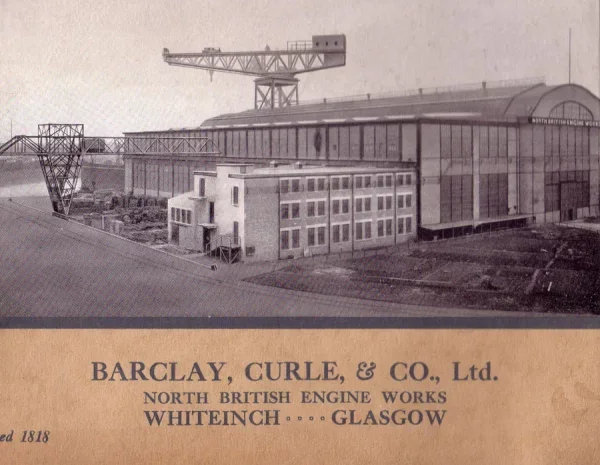
Not literally — we're not welding hulls together in a shed — but our workshop sits inside the Barclay Curle Complex at 739 South Street, Whiteinch, Glasgow, G14 0BX. It's a site with over a century and a half of industrial history behind it, and it's hard not to feel that history when you're standing in a building that once helped build some of the ships that made the Clyde famous around the world.
We think that matters. Label Home is built on reclaimed scaffold board, salvaged timber, and cast iron fittings that have already lived a working life somewhere else. Making our pieces inside a former shipyard, in a building that has already outlasted the industry it was built for, feels like the right kind of home for that.
Why Whiteinch?
Whiteinch sits on the north bank of the River Clyde, a few miles west of Glasgow city centre. For most of the 19th and 20th centuries, this stretch of the river was one of the most productive shipbuilding corridors on earth. Barclay Curle was one of the yards that made it that way.
A brief history of Barclay Curle
The firm traces back to 1818, when John Barclay set up as a shipbuilder at Stobcross, near what is now the site of the Finnieston Crane in Glasgow's city centre. It was very much a family business in its early years — John's sons Thomas and Robert took over, and in 1845 Robert brought in James Hamilton and Robert Curle as partners, trading as Robert Barclay & Curle. The firm's name settled into Barclay, Curle & Co in the 1860s.
By the 1850s the company had outgrown Stobcross and opened a new yard further down the river at Whiteinch, known as the Clydeholm Shipyard. The move to Whiteinch became permanent when the old Stobcross site was sold off in the 1870s. From here, Barclay Curle grew into one of the major shipbuilders on the Clyde, turning out sailing ships, steamers, and eventually steel-hulled vessels as shipbuilding technology moved on. The yard built merchant ships, passenger steamers, and — during the First World War — a number of gunboats and other vessels for the Royal Navy.
In 1912, Barclay Curle was taken over by the Tyneside shipbuilder Swan Hunter, though it kept building ships under its own name at Whiteinch. The company also branched into marine engineering, and in 1913 built the North British Diesel Engine Works at the Clydeholm site — a striking piece of early modernist industrial architecture that still stands today. A few years later, in 1920, engineering firm Sir William Arrol & Co (the same firm behind the Forth Bridge) built a huge Titan crane next to the engine works. That crane is still there now, one of only four such cranes left standing on the Clyde.
Shipbuilding at the Whiteinch yard continued through two World Wars, with the yard building troop transports, escort ships, and other vessels to support the war effort. But like much of Britain's shipbuilding industry, Barclay Curle struggled against overseas competition in the postwar decades, and the Clydeholm yard finally stopped building ships in the late 1960s.
From shipyard to workshop
Rather than falling derelict, the old Barclay Curle site found a second life. Through the 1980s it was gradually redeveloped into an industrial complex, and today it's home to a mix of small businesses, workshops, and makers — us included.
We like that continuity. The buildings that once rang with the sound of riveting and steel-cutting now house people making things by hand, on a smaller scale, but with the same care for materials and craft that the shipyard workers would probably recognise. Every time we source a length of reclaimed scaffold board or an old cast iron bracket for a Label Home piece, we're carrying on a version of what this site has always done: taking raw, honest materials and turning them into something built to last.
Come and see us
If you're in Glasgow, our workshop is at 739 South Street, Whiteinch, G14 0BX — just along from the Barclay Curle crane, which is well worth a look if you haven't seen it up close. You can also find our finished pieces in person at Scottish Design Exchange on Sauchiehall Street, or browse the full range on our website.
Next time you pick up a Label Home piece, you'll know it was made in a small workshop with a very big history behind it.